scotsphere AI
Menu
Book a demo

CONNECTED HOME CONTROL

A more responsive home, with control kept simple

SmartProperties can connect residents with supported equipment in their home, helping everyday controls become easier to use while giving authorised services a clearer view of the technology they manage.

The capability is organised around the property and the resident—not around a collection of unrelated devices. The controls available in each deployment are determined by the supported equipment, agreed integrations and permissions configured for the service.

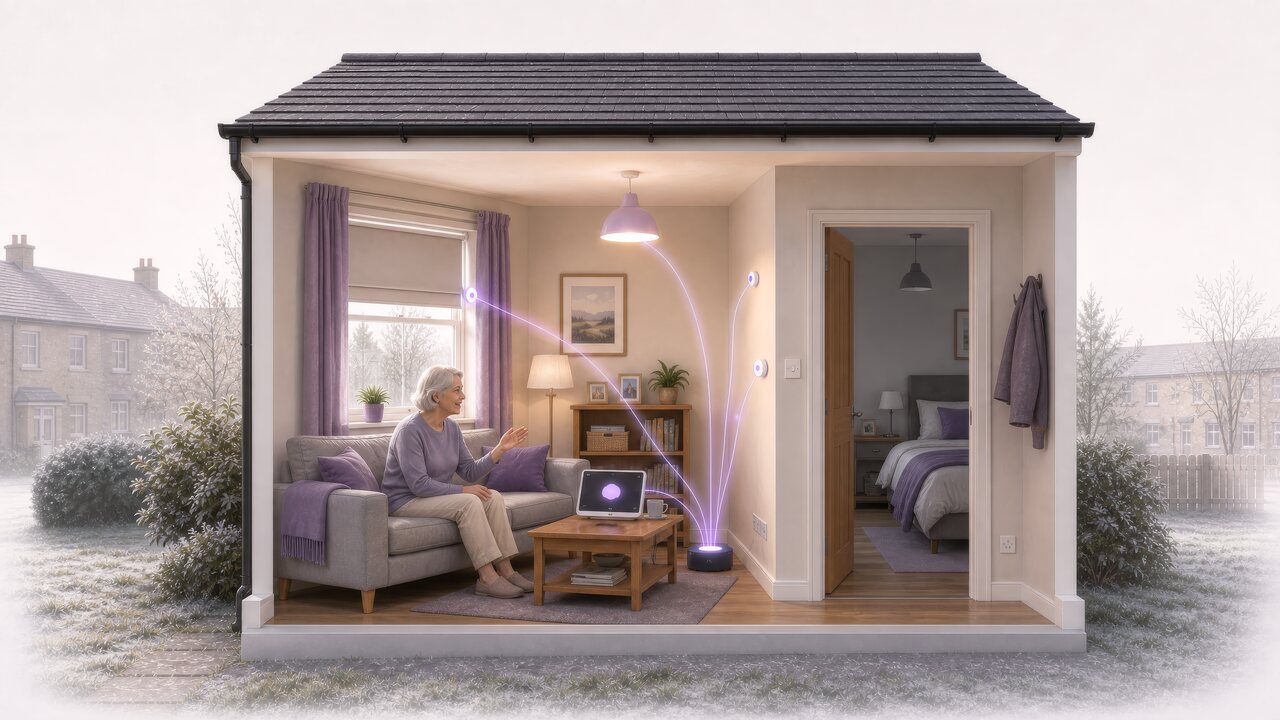
Resident using a voice-enabled display to control connected lighting and a window blind through the home SmartHub.

Everyday control that can support greater independence

For some residents, operating a light, blind or other item of supported equipment can be inconvenient or physically difficult. Connected controls can provide a more accessible way to interact with the home, using the interface and permissions agreed for the service.

The same connection can help the organisation understand which managed equipment is associated with the property, whether relevant status information is available and where operational attention may be needed.

featuretypical content

Resident access

Make routine actions easier to reach

Compatible equipment can be connected to an approved resident interface so that common actions can be made more accessible. The precise interaction method is selected and validated for the resident, equipment and service.

featuretypical content

Property context

Keep each control connected to the right place

SmartProperties associates managed equipment with the correct property and, where relevant, the room in which it is installed. That context helps distinguish, for example, a bedroom light from equipment serving another part of the home.

featuretypical content

Service visibility

Give responsible teams clearer operational information

Where a supported device or integration provides suitable evidence, authorised staff can see relevant identity, assignment, readiness and connectivity information. Missing or unavailable evidence is kept distinct from a confirmed fault or offline state.

A managed connection between the home and the service

In deployments using a SmartHub, it provides a managed connection between supported equipment in the property and the wider SmartProperties service.

It can bring together different in-home integration methods without requiring the resident to understand the protocol or supplier behind each device. Bluetooth Low Energy, or BLE, is one such method; other protocols and provider platforms may be used where they are supported by the selected SmartHub, equipment and deployment design.

Connect supported equipment

The SmartHub provides the in-home foundation through which validated equipment can be associated with SmartProperties. Connection does not follow from a protocol label alone: the exact model, integration path and required functions must be supported and configured.

Maintain the link to SmartProperties

The SmartHub connects in-home equipment to the governed property record and the authorised services responsible for it. Management information remains tied to its source, time and scope rather than being presented as certainty about the physical condition of the home.

Keep technical complexity behind the service

Residents interact with the controls made available to them. Device protocols, provider identifiers and integration details remain part of the managed technical service rather than becoming something the resident has to coordinate.

Equipment can change without losing the story of the home

Connected equipment has its own identity and lifecycle, but the property and room remain the stable context around which the service is organised.

SmartProperties separates its internal record from a manufacturer’s or provider’s identifier. This means that replacing a device does not have to erase the history of the room, property or service it supported.

featuredemanding content

Associate the equipment

A supported device is recorded against the correct property and, where required, the correct room. The association identifies where it belongs without confusing assignment with live connectivity.

featuredemanding content

Understand its current evidence

Relevant information can include the device model, assignment, lifecycle state and the last authoritative evidence available from its integration. Readiness, connectivity and health are presented only to the extent supported by the source.

featuredemanding content

Replace or reassign it under control

When equipment is replaced, removed or reassigned, SmartProperties can preserve the required assignment and audit history while creating a clear record for the new device. The exact migration or recommissioning route depends on the equipment, protocol and manufacturer.

featuredemanding content

Retain the property context

Observations, service history and room context remain associated with the property rather than becoming dependent on one physical device. Retention and deletion continue to follow the organisation’s agreed policy.

Resident control and service management have different responsibilities

A resident needs a straightforward way to use the controls intended for them. The organisation needs governed ways to configure, support and manage the equipment for which it is responsible.

SmartProperties keeps those responsibilities distinct. A resident-facing control does not automatically grant administrative access, and visibility in a management service does not by itself authorise remote operation of equipment in the home.

Controls designed around the resident

The available interaction can be configured around accessibility needs, the supported equipment and the purpose of the service. Where voice or display devices form part of the design, only the interactions validated for that deployment should be made available.

Management within an agreed scope

Authorised staff can be given the information and actions appropriate to their role, organisational area and service responsibility. Higher-impact changes should remain subject to explicit permission, validation, confirmation and audit.

Each organisation defines what the service permits

The customer configuration determines the supported device catalogue, property and room structure, resident controls, staff permissions, integration routes and operational behaviour. These choices remain within the common SmartProperties identity, evidence, security and audit model.

A connected-home capability that can evolve without fragmenting the property record

Resident needs, equipment and suppliers will change over time. SmartProperties provides a consistent property-centred foundation on which supported controls can develop without creating a separate record for every point solution.

New equipment or integration methods can be considered through controlled onboarding and compatibility assessment. Where they are supported, they can use the same property, room, identity, permission and lifecycle structure as the existing connected estate.

Compatibility is established for the equipment and service being delivered

SmartProperties provides the architecture for connected home control. The controls available in a particular home depend on validated equipment, supported integrations and the organisation’s agreed service configuration.

featuredemanding content

Established foundation

Property-centred device management

The SmartProperties architecture supports stable device identity, property and room association, lifecycle history, source-aware status evidence and a managed in-home router connection.

featuredemanding content

Customer configuration

Devices, permissions and service behaviour

Each deployment defines its approved equipment, integration methods, resident interactions, staff permissions and operational processes within the common SmartProperties controls.

featuredemanding content

Subject to validation

Control of lights, blinds and other equipment

Lighting, blinds and other equipment should be presented as controllable only after the exact products, functions and integration route have been validated. The architecture provides the foundation for this capability; it does not establish universal compatibility or general availability.

featuredemanding content

Separately evidenced

Automation, recovery and remote operation

Automatic routines, operation during an outage, remote recovery and service-initiated control require their own technical, permission and acceptance evidence. They should not be assumed from device connectivity alone.

Explore a connected-home service built around the resident

Talk to scotsphere AI about the controls that could make a meaningful difference in the home, the equipment and integrations available to support them, and the governance your organisation needs.

We can help you explore a focused SmartProperties configuration that keeps the resident experience simple while preserving the property, device and service context behind it.